The MRC Human Genetics Unit is tackling the huge issue of how we interpret the genome (the complete set of DNA within a species) to better understand and treat human disease. Our researchers work hand in hand with NHS staff, including doctors and the NHS testing services, and people affected by genetic disorders.
Millions of human genomes have been sequenced around the world but understanding the significance of genetic variation at the level of molecules, cells, tissues, or people lags behind. The MRC HGU is tackling this challenge by investigating the mechanisms of how genetic variants affect disease.
Silver-Russell syndrome (SRS), also called Russell-Silver syndrome (RSS), is a genetic condition and rarely, it can be inherited but most people who have RSS don’t have a family history of the disease. Globally, 1 in 15,000 people are born with this condition.
Diagnosis of RSS can be difficult because many GPs and Paediatric Consultants may not be familiar with this condition. People born with this condition are born small and often have limb or facial asymmetry (irregularity). Growth is affected during childhood and this means that adults with RSS have significantly shorter statures than average.
Symptoms of RSS range from mild to severe, so that these symptoms can go undetected. In some people with RSS, a genetic change is found: 40-50% are found to have a problem on chromosome 11 and in another 5-10% on chromosome 7. Sometimes, the genetic cause cannot be identified. Most cases are not inherited from a parent and occur sporadically. In rare cases, RSS may be inherited – in an autosomal dominant or autosomal recessive manner.
Treatment is focused on managing the symptoms of RSS. As the first few years of life are very important in child development, treatment for RSS focuses on treating its symptoms so that children can develop as normally as possible. As patients grow older, many symptoms improve.
Online Programme
18:00: Welcome & Housekeeping: Dee Davison, IGC Public Engagement Manager
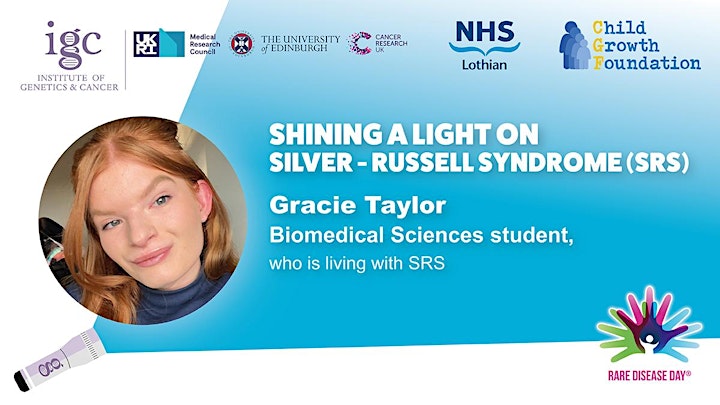
18:10: Conversation between Dr Mary Porteous, Clinical Lead, NHS South East Scotland Rare Disease Genetic Service and Gracie Taylor, who is living with RSS. Mary will outline how the Gracie’s diagnosis was made clinically, and then confirmed on further genetic testing, when Gracie was six months old. Gracie will describe her diagnostic journey and how she lives with RSS – her symptoms, the treatments she has received and her hopes for the future.
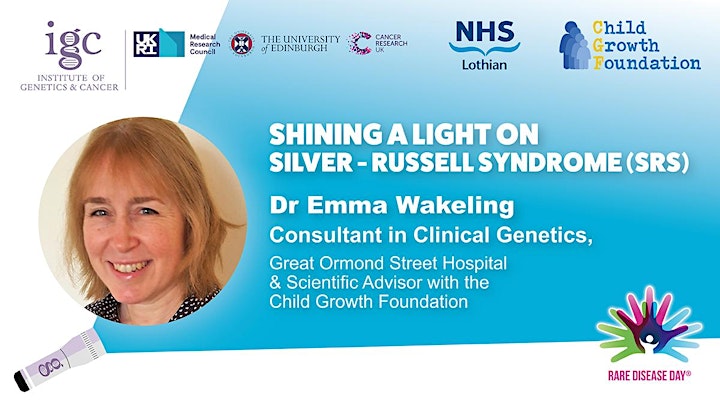
18:40: Dr Emma Wakeling, Clinical Consultant, Great Ormond Street Hospital & Scientific Advisor with the Child Growth Foundation.
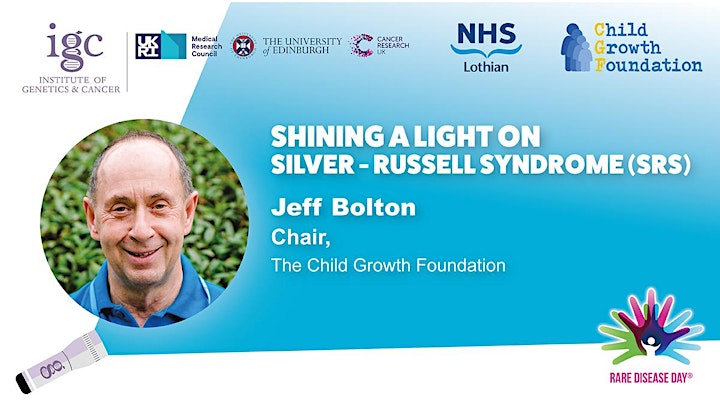
18:55: Jeff Bolton, Chair, The Child Growth Foundation.
19:00: Q&A
19:30: Event ends
ONLINE: Zoom. Joining instructions will be emailed prior to the event.
Gracie Taylor
Gracie is living with Silver Russell Syndrome and is currently in her second year of a Biomedical Sciences degree, specialising in Pharmacology, at UCL. “Initially, my curiosity about the human body began as I realised that my body worked a little differently to everyone else’s. This curiosity shaped my degree choice as I felt like Silver Russell gave me a unique appreciation of just how powerful and impactful biomedical science is. Living with a condition like Silver-Russell, whilst maintaining a busy and fulfilled university life doesn’t come without its challenges. However, despite the added layer of complexity that comes with a rare condition like Silver-Russell, I am living an incredibly independent and normal student life. I want to share my experiences, both as a child and now as a young adult, and by doing so shine some light on RSS and the need for these important conversations about these rare conditions.”
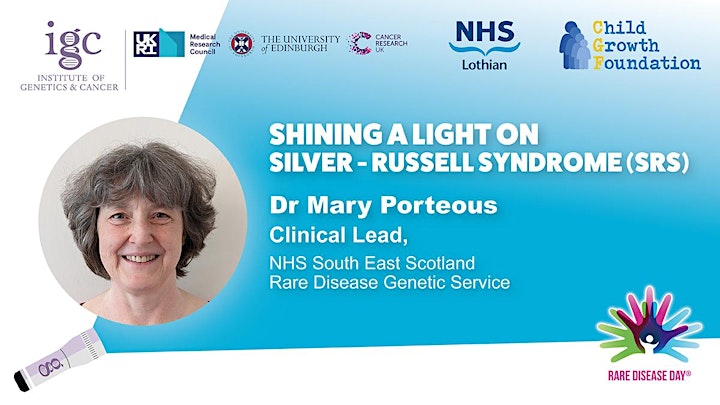
Dr Mary Porteous
Mary was appointed as the first NHS Consultant Clinical Geneticist in Edinburgh in 1992. Mary is currently Service Lead for the SE Scotland Genetic Service and is an honorary Professor at the IGC. Mary’s first exposure to Genetics was as an MSc student in Glasgow where Mary spent many hours clinically characterising Aarskog syndrome (an X-linked short stature syndrome) and mapping the FDG1 gene responsible for Aarskog syndrome. Mary trained in Newcastle under the supervision of Professor John Burn. Mary’s research initially focussed on gene mapping and cloning collaborating with Doug Marchuk (Duke university) and her husband Austin Diamond (then also at Newcastle) in the mapping and cloning of ENG and ACVRL1, the major genes involved in Hereditary Haemorrhagic Telangiectasia.
Mary was the Clinical Genetic lead on implementation of the Scottish Government ‘Calman Report’, which lead to a significant increase in funding for genetic services. In 2009, Mary chaired the Scottish Government Molecular Pathology Review Group that established the principle of central funding for genetic services via the Scottish Genetic Consortium. As a clinician, Mary’s research focus has more recently been around the translation of research discoveries into the NHS diagnostic sphere. Over her career, Mary has developed long lasting collaborations with colleagues in the IGC, particularly with Malcom Dunlop and Charlie Gourlay, resulting in several publications. Mary was a Director on the Board of the Scottish Huntington’s Association for many years and is a strong believer in partnership between patients, family members and professionals in tackling the impact of inherited disorders.
Dr Emma Wakeling
Dr Emma Wakeling is a Consultant in Clinical Genetics and Genomic Medicine with the North East Thames Regional Genetic Service, Great Ormond Street Hospital. Emma sees patients with a wide range of childhood genetic disorders and has a specialist clinical and research interest in disorders of imprinting and growth failure, including Silver-Russell syndrome (SRS). Emma qualified with an MA from the University of Oxford (1989) and MBBS from the United Medical and Dental Schools of Guys and St Thomas’ Hospitals (1992). Emma was awarded a PhD by the University of London in 1999 for her work researching the underlying molecular cause of SRS. Emma was appointed as a Consultant at North West Thames Regional Genetic Service in 2004, where Emma was Clinical Lead from 2015 – 2018. From 2019, Emma has been a consultant at North East Thames Regional Genetic Service, based at Great Ormond Street Hospital (GOSH). Emma’s work focuses on diagnosing rare genetic conditions in patients with complex paediatric disorders. Emma runs a specialist clinic jointly with the endocrine team at GOSH for children with suspected or diagnosed disorders associated with early growth failure, including SRS. Emma is Medical Advisor to the Child Growth Foundation and the SRS Global Alliance.
Jeff Bolton
A BSc (Hons) and MBA graduate, Jeff joined the pharmaceutical industry in 1990. Jeff first worked for Janssen-Cilag, where he performed a number of commercial and marketing management roles. Jeff joined Pfizer in 2002 as Senior Brand Manager in the Endocrinology Team and transitioned into a European marketing role in 2006. Jeff became European Brand Director in 2010. Jeff left Pfizer in 2016 to start his own consultancy company, JRB Consultancy Services Ltd. Jeff has been involved with growth conditions for over 20 years, and has won numerous awards, both national and international, for his role in developing campaigns and support information and materials for families affected by growth conditions. Jeff was the European lead for the development of the first growth prediction tool, iGRO, which was sponsored by Pfizer, and has since been rolled out in more than 25 countries. Jeff has been a trustee of the Child Growth Foundation for over two years and became their Chair in 2022.
WEBSITES:
• NHS UK: https://www.genomicseducation.hee.nhs.uk/genotes/knowledge-hub/silver-russell-syndrome/#:~:text=Silver%2DRussell%20syndrome%20(SRS),Clinical%20features
• NIH USA: https://rarediseases.info.nih.gov/diseases/4870/russell-silver-syndrome
• Russel Syndrome Org (Global Alliance for RSS): https://silverrussellsyndrome.org/
• Child Growth Foundation: https://childgrowthfoundation.org/
• Magic Foundation (USA): https://www.magicfoundation.org/About/
• Global Genes: https://globalgenes.org/
• NHS South-East Scotland Rare Disease Genetic Service: https://weare.nhslothian.scot/geneticservice/clinical-genetic-service/
• Genomic Data Analysis Centre (GDAC): https://www.ed.ac.uk/institute-genetics-cancer/facilities/the-genomic-data-analysis-centre
ANY QUERIES
Email: IGC Public Engagement (Dee): [email protected]
EVENT PHOTOGRAPHY/VIDEO
Video recording will take place during this ONLINE event. IGC Event photographs and recordings will be held by the Institute of Genetics and Cancer at the University of Edinburgh and may be used after the event on the Institute’s websites, social media channels and printed materials. If you do not wish to be photographed/filmed, please make a member of staff aware during the event or contact [email protected]
PRIVACY STATEMENT
Information about you: how we use it and with whom we share it.
We want to run a safe and accessible event and provide the best possible experience for you. By providing any information required on this booking form, you are giving the University consent to hold and process this data about you and to advise our suppliers of these details, under data protection regulations, for the purpose of running this event.
We will use your personal data to allow us to process your registration, communicate with you and potentially obtain your feedback about the event. We are processing the information about you for these purposes because by registering for the event, you are entering into a contractual agreement for us to do so.
In order to facilitate online bookings for our events, we use Eventbrite – a third party service, which is not operated by the University of Edinburgh. Details of Eventbrite’s privacy policy can be found at www.eventbrite.co.uk/support/articles/en_US/Troubleshooting/eventbrite-privacy-policy
If you wish to attend an event organised by the Institute of Genetics and Cancer but do not wish to use Eventbrite, please email us at [email protected]
Only if you have given us your permission, we will share your name, affiliation and contact details with the other participants in the delegate list. We will not share information about you with any other third party.
After the event, we will send you an event evaluation survey as it is our legitimate interest to help us improve any future events we organise. We may email you in the future with further information and to promote events that may be of interest to you.
All personal information is held securely by the University and in accordance with Data Protection Law. We use information about you because we have a legal obligation to do so, you have provided consent, or we believe it is in our legitimate interest. The University, or other parties acting under the instructions of the University, for a range of activities, will use the data we hold.
We will hold the personal data you provided us for 6 months. If you have agreed to be contacted about future events, we will hold your personal data for as long as you subscribe to these updates. Where provided, financial data such as a payment record will be held for 7 years, but we will ensure that all information that can identify you directly is removed after 6 months. We do not use profiling or automated decision-making processes.
If you have any questions, please contact [email protected]
This Privacy Statement is continued at www.edin.ac/privacy